Good documentation is part of the program
Correct code can still fail learners when explanation does not match context. A robust reading explains goal, input shape, and why each key return exists.
Use the What, Why, How format
What: this function filters invalid entries.
Why: bad input should not break loops.
How: validate first, process clean values, return structured output.
Add tests to your reading narrative
Show one failing test, one fixed test, and one boundary case in each lesson.
- input length zero
- one valid entry
- duplicate entry
Documentation-ready code block
def filter_non_empty(items):
    """Return only non-empty, trimmed text entries."""
    return [x.strip() for x in items if isinstance(x, str) and x.strip()]

print(filter_non_empty(['', '  learn ', None, 'data']))
Understanding the central idea
Professional project communication explains the problem, the decisions, and the evidence behind the result. Code alone rarely shows how a developer handled constraints, recovered from mistakes, or made the work usable by someone else.
The purpose of this article is to connect that idea to a complete working flow. Individual commands matter, but the lasting skill is understanding why each part exists and how information moves from the user's action to a trustworthy result.
Begin with the nouns and verbs in the problem. The nouns usually become data—such as a user, transaction, note, file, or task—while the verbs become operations such as create, validate, calculate, update, and report. This simple translation gives the project a shape before framework or library choices distract from the core behaviour.
It also helps to separate facts from derived values. Store facts that arrived from a trusted input and calculate summaries from those facts when possible. Duplicating calculated totals in several places creates inconsistencies because one copy can change while another remains stale.
How the pieces work together
Small commits preserve a readable history, branches isolate a focused change, documentation explains setup and behaviour, and a portfolio summary connects technical work to a user outcome. Together they make review faster and collaboration safer.
Build the smallest successful path first. Keep input handling, core logic, storage, and presentation distinct even when they live in one file. This makes the project easier to explain today and easier to split into modules when it grows.
Validation belongs close to the boundary where new data enters. The core logic can then work with values that already satisfy basic rules. Persistence should receive a complete valid change, while presentation should translate the outcome into language the user understands. This order prevents a partially processed request from leaking into saved data.
Naming is part of the design. A function such as calculate_monthly_total communicates more than process, and a value such as normalised_category shows that a transformation has already happened. Clear names reduce the amount of state a beginner must remember while reading the code.
A realistic flow from start to finish
A useful project entry begins with the user problem, shows the smallest working flow, names two important technical decisions, links to the source and live result, and describes one difficult bug. Screenshots support that story but do not replace it.
Follow one record through the whole system and inspect its value after every meaningful transformation. This is more instructive than copying a finished code listing because it reveals where assumptions enter the program and where an incorrect value would first become visible.
For the first implementation, use a tiny dataset that can be checked by hand. Three or four records are usually enough to expose ordering, totals, duplicates, and empty-state behaviour. Once the hand-calculated result agrees with the program, add a larger or messier input and observe which assumptions no longer hold.
Keep the successful flow visible in the interface or console output. The result should confirm what changed and include the identifier or summary needed for the next action. A generic message such as “done” hides useful evidence and makes later debugging unnecessarily difficult.
Reliability and common failure points
Remove secrets and personal data, verify every public link, include exact setup steps, and test the project from a clean environment. Claims such as fast, secure, or production-ready need measurements or specific evidence.
Treat error handling as part of the user experience. A useful error message says what failed, what remained safe, and what action can be taken next. During development, keep technical detail in logs while presenting concise recovery guidance to the reader or end user.
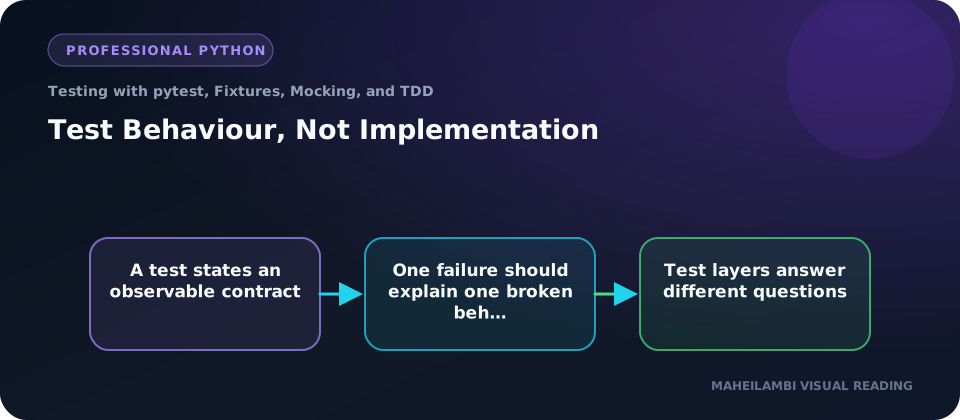
Test failures at the same layer that owns the rule. Input-format tests belong near validation, calculation examples belong near the core logic, and save-and-reload checks belong near persistence. This makes a failed test point toward one responsibility instead of forcing the learner to inspect the entire application.
Retries also need care. A retry should not create a duplicate record or repeat a payment-like action. Stable request identifiers, uniqueness rules, or an explicit check before writing make repeated actions safe. Even a beginner project benefits from understanding that users double-click buttons and networks repeat requests.
What a complete result demonstrates
A reviewer should understand the project's purpose in under a minute and still have enough detail to inspect implementation quality, trade-offs, and the developer's role.
At that point, improvements such as a richer interface, more automation, or cloud deployment become controlled extensions rather than substitutes for an unfinished core. The result is a project that teaches transferable reasoning as well as syntax.
Document the final flow in a short README with setup steps, one realistic example, expected output, and known limitations. This turns the project into something another person can run and review. It also reveals missing assumptions that were obvious only on the original developer's computer.
The best next improvement is the one supported by evidence from actual use. A confusing message may matter more than a new chart, and protecting saved data may matter more than adding another button. This prioritisation habit is one of the most valuable lessons an end-to-end project can teach.
Worked case study: from problem to evidence
This is an illustrative case study designed to make the engineering decisions concrete. It does not claim results from a named organisation; every conclusion follows from the described inputs and observable behaviour.
Starting situation
A capable beginner submits a portfolio project, but the repository contains one giant commit, unclear setup steps, broken screenshots, and no explanation of the developer's decisions. Reviewers cannot reliably run or assess the work.
Intervention
The project is reorganised around a readable README, focused commits, verified links, a concise architecture note, and a case-study summary covering the problem, constraints, decisions, evidence, and limitations.
Evidence collected
A fresh clone can be installed using only the documented steps, every link resolves, commit history explains major changes, and a reviewer can identify the project outcome without opening every source file.
Practical lesson
Communication is part of engineering quality. Clear evidence helps good implementation become visible and makes collaboration less dependent on the original author.
A useful case study separates observation from opinion. The starting state records the problem, the intervention records what changed, and the evidence shows whether the change produced the intended behaviour. This structure helps readers evaluate an approach instead of accepting a success claim without support.
Test cases and expected behaviour
The following cases act as an executable specification. They are not questions for the reader; they state the conditions, expected outcomes, and reason each check matters.
| Test case | Input or condition | Expected result | Knowledge gained |
|---|---|---|---|
| Fresh setup | Clone into a clean environment | Documented commands produce a working result | Detects hidden local dependencies. |
| Link audit | Open every source, demo, and image link | All targets resolve correctly | Protects reviewer trust. |
| Secret scan | Inspect tracked files and history | No keys or private data | Prevents a serious publishing mistake. |
| One-minute review | README and project card only | Purpose, role, stack, and outcome are clear | Tests communication rather than code execution. |
Run the smallest test first and keep its input stable while repairing a failure. When it passes, add boundary and recovery cases. Changing code and test data simultaneously makes the source of improvement difficult to identify.
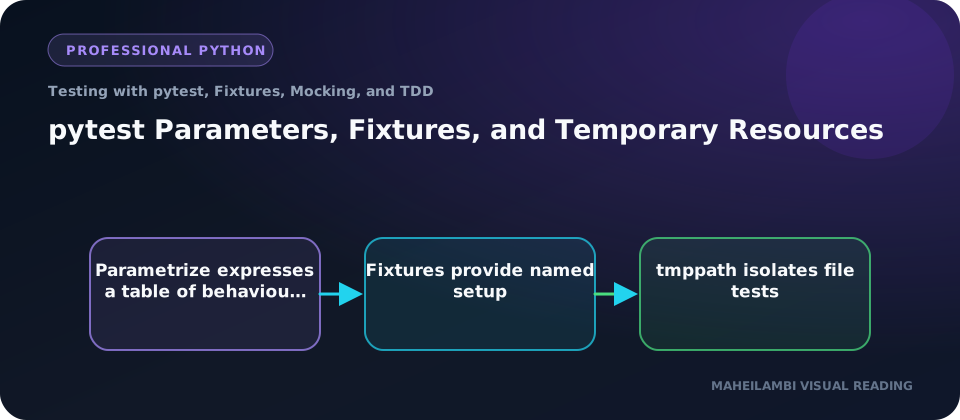
For automated tests, use the same arrange-act-assert pattern throughout the project. Arrange creates a known starting state, act performs one behaviour, and assert compares the observable result with the documented expectation. A good assertion checks the outcome that matters to the user, not an internal implementation detail that may change during refactoring.
Interpreting test failures
A failed test is evidence of a mismatch between the implemented behaviour and the written expectation. First confirm that the expectation represents the intended product rule. Next reduce the failure to the smallest input that still reproduces it, inspect the boundary between stages, and change one cause at a time.
Failures often reveal missing product decisions rather than typing mistakes. An empty value, repeated request, unavailable service, or partial save forces the application to choose a behaviour. Recording that decision in both the article and the test suite prevents future changes from silently reintroducing the same uncertainty.
The final test report should state the revision tested, environment, cases executed, results, and any untested limitation. That short record turns “it worked for me” into evidence another learner or reviewer can evaluate.